Arbitrage Bot Explained
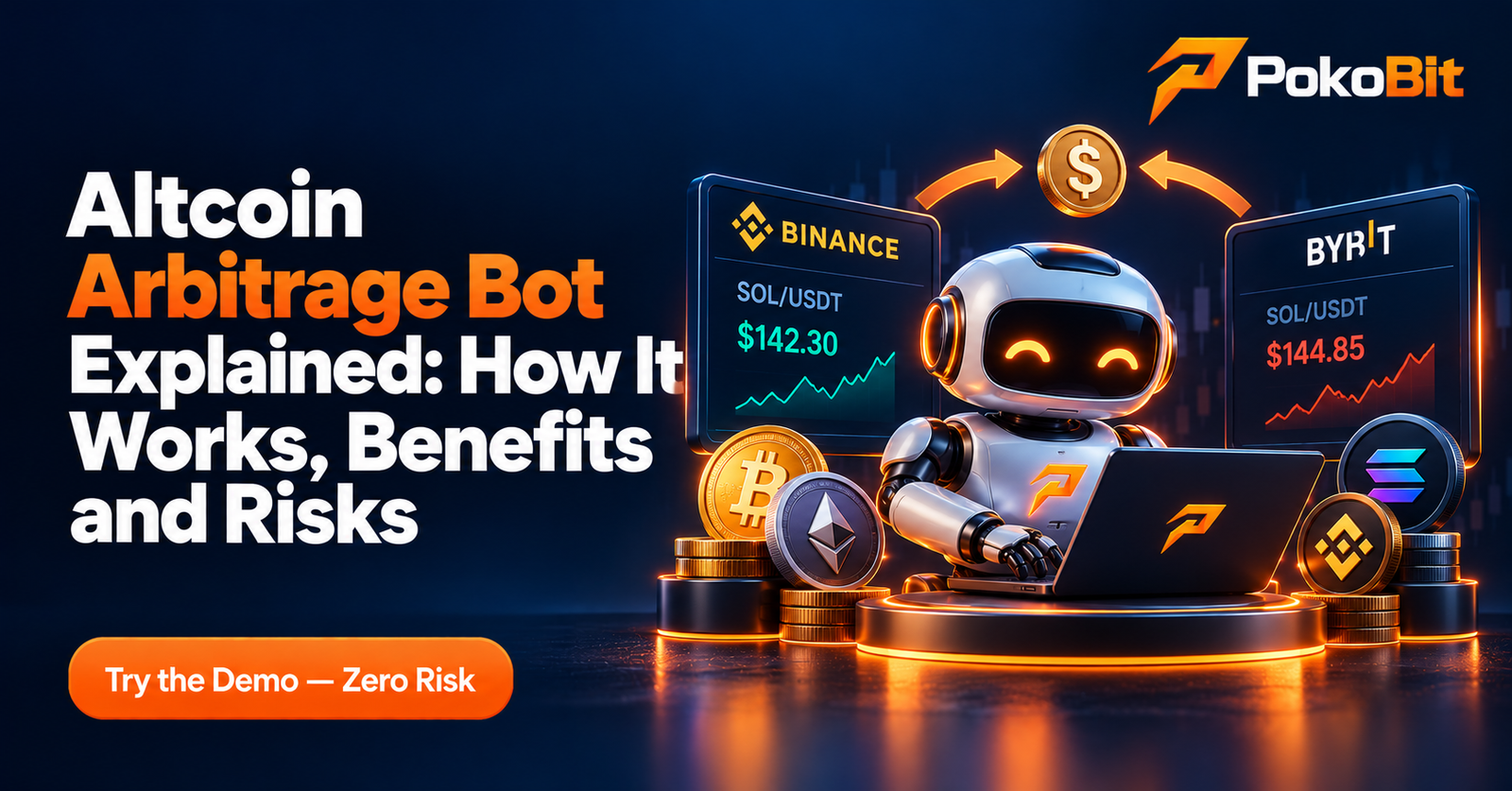
An altcoin arbitrage bot is automated software designed to monitor cryptocurrency markets for price differences and, depending on its configuration, execute trades when predefined conditions are met.
The basic idea behind arbitrage is straightforward: buy an asset at a lower effective price in one market and sell it at a higher effective price in another.
For altcoins, these differences can occur across centralized exchanges, between centralized and decentralized markets, or between different trading pairs.
However, an apparent price difference is not automatically a profitable opportunity. Trading fees, liquidity, slippage, transfer delays and execution speed can significantly affect the final result.
What Is an Altcoin Arbitrage Bot?
An altcoin arbitrage bot is a program that automates parts of the process of finding and potentially executing arbitrage trades involving altcoins.
For example, imagine SOL is trading at:
Exchange A: $150.00
Exchange B: $151.00
The bot can detect the $1 difference and determine whether the opportunity meets its configured requirements.
If the conditions are satisfied, it may place a buy order on Exchange A and a sell order on Exchange B.
The bot’s job is not simply to find the biggest spread. A properly designed system should consider whether the spread is large enough to potentially cover trading costs and execution effects.
How Does an Altcoin Arbitrage Bot Work?
1. Connects to Exchange APIs
Most automated arbitrage systems use exchange APIs to obtain market information.
Depending on the permissions granted, an API connection can allow software to:
- Read prices
- Read order books
- Check balances
- Submit orders
- Monitor open orders
- Receive trade updates
API access should be configured carefully, with only the permissions required by the bot.
2. Monitors Multiple Altcoins
The bot can monitor several altcoins simultaneously.
For example:
- SOL/USDT
- XRP/USDT
- ADA/USDT
- DOGE/USDT
- AVAX/USDT
- LINK/USDT
- SUI/USDT
Monitoring multiple markets gives the system more opportunities to identify temporary price discrepancies.
3. Compares Prices
The bot compares the relevant prices across exchanges.
For example:
Exchange A
SOL ask: $150.00
Exchange B
SOL bid: $151.20
The apparent difference is:
$1.20
But the bot should then evaluate whether enough SOL is available at those prices.
4. Checks Liquidity
Liquidity is critical.
A displayed price may only be available for a small amount of an asset. If the bot attempts to execute a larger order, it may consume several levels of the order book.
This can cause the average execution price to move against the strategy.
Binance’s current trading analysis guidance specifically emphasizes order-book depth, fees and slippage when determining the effective execution price.
5. Calculates the Spread
A basic calculation is:
Gross Spread = Selling Price − Buying Price
For example:
$151.20 − $150.00 = $1.20
The bot can then convert the difference into a percentage.
6. Calculates Potential Net Result
A more useful calculation is:
Net Potential Result = Gross Spread − Trading Fees − Slippage − Transfer Costs − Other Applicable Costs
This is important because arbitrage spreads can be relatively small, and costs can consume much of the apparent opportunity.
7. Executes the Trade
If the opportunity satisfies the bot’s rules, it can submit the relevant orders.
The objective is to execute the two sides of the strategy as close together as possible.
This matters because arbitrage opportunities can disappear quickly.
Example of Altcoin Arbitrage With a Bot
Suppose an automated system identifies:
SOL on Exchange A: $150.00
SOL on Exchange B: $151.50
The gross difference is:
$1.50 per SOL
If the strategy trades 1,000 SOL:
Gross spread = $1,500
Now assume the estimated costs are:
Buy-side fees: $300
Sell-side fees: $300
Slippage: $400
Other costs: $100
The estimated amount remaining would be:
$1,500 − $1,100 = $400
This is only an illustration. Actual fees, liquidity and execution prices vary by exchange, account and market conditions.
The important lesson is that the $1,500 gross spread is not the same as $1,500 profit.
Why Use an Altcoin Arbitrage Bot?
Faster Market Monitoring
A bot can monitor markets continuously instead of requiring a trader to manually check prices.
Multiple Exchanges
It can compare several exchanges at the same time.
Multiple Trading Pairs
A bot can monitor numerous altcoin pairs simultaneously.
24/7 Monitoring
Crypto markets operate continuously, so automated monitoring can continue when the trader is unavailable.
Consistent Rules
The bot can follow predefined conditions without changing its decisions because of emotions.
Faster Execution
Automated systems can react to opportunities faster than manual trading, which is particularly relevant because arbitrage spreads can close quickly.
Altcoin Arbitrage Bot vs Manual Arbitrage
| Feature | Manual Arbitrage | Altcoin Arbitrage Bot |
| Price monitoring | Manual | Automated |
| Multiple exchanges | Difficult | Easier |
| Multiple altcoins | Difficult | Easier |
| Speed | Slower | Faster |
| 24/7 monitoring | Difficult | Possible |
| Alerts | Manual | Automated |
| Trade execution | Manual | Can be automated |
| Technical complexity | Lower | Higher |
Automation makes monitoring and execution more efficient, but it also introduces additional technical risks.
What Should a Good Altcoin Arbitrage Bot Monitor?
A useful bot should look beyond the headline price.
Bid and Ask Prices
The bot should distinguish between the price available to buyers and sellers.
Order-Book Depth
It should determine whether sufficient liquidity exists for the intended trade.
Trading Fees
The system should account for the actual maker or taker fees applicable to the account.
Exchange fee structures can vary by trading volume, account tier and other conditions.
Slippage
The bot should estimate how the intended order size could affect the execution price.
Slippage becomes more important when liquidity is limited or markets are moving quickly.
Transfer Costs
If the strategy requires moving assets between exchanges, withdrawal and network costs should be included.
Execution Time
The bot needs to account for the possibility that the spread disappears before both sides of the trade are completed.
Risks of an Altcoin Arbitrage Bot
Automation does not eliminate trading risk.
Execution Risk
The spread can disappear between detection and execution.
This is one of the most important risks in crypto arbitrage.
Liquidity Risk
There may not be enough liquidity to execute the intended trade at the displayed price.
Slippage
The actual execution price can differ from the expected price.
Low-liquidity altcoins can experience particularly significant slippage.
API Risk
Exchange APIs can experience delays, rate limits, errors or outages.
Software Risk
A programming error or incorrect configuration could cause unintended trades.
Security Risk
API credentials need to be stored and managed securely.
Market Risk
Altcoins can move sharply in a short period, potentially affecting one side of an arbitrage strategy before the other side is completed.
Should an Arbitrage Bot Transfer Coins Between Exchanges?
Not necessarily.
One approach is to maintain balances on multiple exchanges.
For example, a trader could keep:
USDT on Exchange A
and
SOL on Exchange B
If an opportunity appears, the trader may be able to execute both sides without waiting for a blockchain transfer.
This can reduce transfer delays, although it means capital is distributed across multiple platforms.
Binance’s current arbitrage guidance notes that maintaining funded accounts on multiple exchanges can allow faster execution without waiting for deposit or withdrawal confirmations.
How to Choose an Altcoin Arbitrage Bot
Before using a bot, check:
Exchange support: Does it support the exchanges you use?
Trading pairs: Can it monitor the altcoins you want?
Fee calculations: Does it include your actual trading costs?
Liquidity analysis: Does it consider order-book depth?
Risk controls: Can you set maximum trade sizes and minimum spreads?
API security: What permissions does it require?
Error handling: What happens if an order fails?
Emergency controls: Can trading be stopped quickly?
These factors can be more important than simply choosing a bot that advertises the largest number of supported exchanges.
Can an Altcoin Arbitrage Bot Guarantee Profit?
No.
A bot can automate a strategy, but it cannot guarantee that every detected opportunity will result in a profit.
Arbitrage opportunities can disappear quickly, while fees, slippage and liquidity limitations can reduce or eliminate the potential margin.
The purpose of automation is to improve monitoring and execution—not to remove market risk.
Final Thoughts
An altcoin arbitrage bot can automate the process of monitoring cryptocurrency markets, identifying potential price discrepancies and, when configured for it, executing trades.
Its biggest advantages are speed, continuous monitoring and scalability.
But a bot is only as effective as the strategy behind it.
Before executing an opportunity, the system should consider the actual buy and sell prices, liquidity, trading fees, slippage, transfer costs and execution risk.
The largest displayed spread is not necessarily the best opportunity.
The better question is:
How much of that spread remains after realistic execution costs?
Explore PokoBit
Explore PokoBit for more crypto arbitrage strategies, market insights and cryptocurrency trading resources.
Frequently Asked Questions
What is an altcoin arbitrage bot?
An altcoin arbitrage bot is automated software that monitors cryptocurrency markets for price differences involving altcoins and may execute trades according to predefined rules.
How does an altcoin arbitrage bot work?
It collects market data, compares prices, checks liquidity, calculates potential spreads and costs, and can execute trades when predefined conditions are satisfied.
Can an altcoin arbitrage bot make guaranteed profits?
No. Arbitrage bots cannot guarantee profits. Execution risk, liquidity, slippage, fees, technical problems and market movements can affect the result.
Which altcoins can an arbitrage bot trade?
That depends on the exchanges and trading pairs supported by the bot. Commonly monitored assets can include SOL, XRP, ADA, DOGE, AVAX, LINK and SUI, but availability varies.
Does an arbitrage bot need exchange API access?
Automated trading bots generally require API access to retrieve market information and, if they execute trades, submit orders. The exact permissions depend on the exchange and software.
Is an altcoin arbitrage bot better than manual trading?
A bot can be faster and monitor more markets simultaneously, but it also introduces technical and security risks. Automation is a tool, not a guarantee of better results.
What is the biggest risk with an altcoin arbitrage bot?
Execution risk is one of the biggest concerns. The price difference can disappear before both sides of the trade are completed, while slippage and insufficient liquidity can further reduce the expected result.