Altcoin Arbitrage Fees and Risks
Altcoin arbitrage involves attempting to take advantage of price differences for the same cryptocurrency across different markets.
The basic strategy is straightforward: buy an altcoin where it is available at a lower effective price and sell it where the effective price is higher.
But the visible price difference is only the starting point.
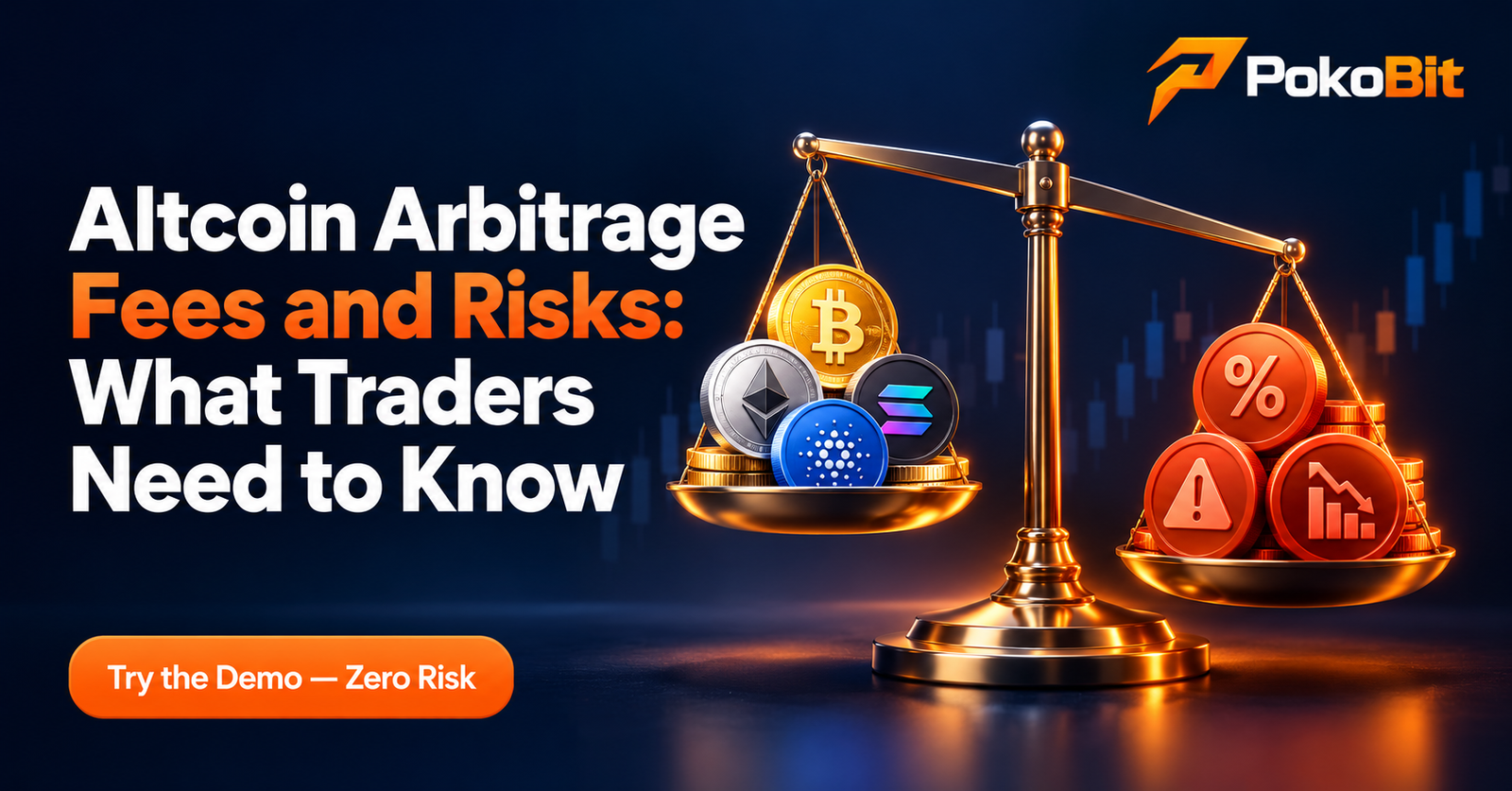
Trading fees, slippage, liquidity, transfer costs and execution risk can significantly reduce the potential return. In some situations, these costs can completely eliminate an apparent arbitrage opportunity. Binance’s current arbitrage guidance specifically highlights trading fees, withdrawal fees, slippage, network costs and execution risk as important considerations. (Binance)
Understanding these costs is therefore essential before evaluating an altcoin arbitrage trade.
What Are Altcoin Arbitrage Fees?
Altcoin arbitrage fees are the various costs associated with buying, selling and potentially transferring an altcoin as part of an arbitrage strategy.
Depending on the strategy, these can include:
- Trading fees
- Bid-ask spread
- Slippage
- Withdrawal fees
- Network fees
- Deposit fees
- Currency conversion costs
- Rebalancing costs
- Funding costs for futures-based strategies
Not every trade will involve every cost, but all relevant expenses should be included when calculating the potential net result.
Trading Fees
Trading fees are among the first costs to consider.
An exchange may charge a fee when you buy an altcoin and another fee when you sell it.
The exact amount can depend on:
- Maker or taker status
- Trading volume
- Account tier
- Trading pair
- Exchange
- Fee discounts
For example, if you pay a fee on both sides of an arbitrage trade, the combined cost directly reduces the spread available to you.
Example
Suppose an altcoin has a gross arbitrage spread of 1%.
If the combined buy and sell trading fees are 0.4%, only approximately 0.6% remains before considering slippage, transfers and other costs.
This is why a seemingly attractive spread may not necessarily represent an attractive trade.
Bid-Ask Spread
The bid-ask spread is another cost that traders need to understand.
The bid is the highest price buyers are currently offering.
The ask is the lowest price sellers are currently requesting.
The difference between them represents the bid-ask spread.
Liquid assets generally have narrower spreads, while less liquid markets can have wider spreads. (Binance)
For arbitrage, this matters because you need to know the price at which you can realistically buy and sell—not simply the last traded price.
Slippage
Slippage occurs when the actual execution price differs from the expected price.
This can happen when:
- The market moves quickly
- There is insufficient liquidity
- The order is large
- The order book is thin
- A market order consumes several price levels
For example, an altcoin might appear to be available at $10.00, but a large order could push the average execution price to $10.15.
That additional $0.15 is an execution cost.
Slippage can be particularly important with lower-liquidity altcoins. (Binance)
Liquidity Risk
Liquidity is one of the biggest considerations in altcoin arbitrage.
A large price difference may appear attractive because there are very few orders available around the current price.
If you attempt to trade a significant amount, your order could move through multiple levels of the order book.
Current CoinGecko liquidity research shows that liquidity varies considerably between major crypto assets and exchanges. Its 2026 research, for example, found relatively shallow DOGE liquidity compared with SOL and highlighted significant differences in order-book depth between exchanges. (CoinGecko)
Therefore, traders should evaluate actual order-book depth for their intended trade size, rather than relying solely on overall market volume.
Withdrawal and Transfer Costs
Cross-exchange arbitrage may require moving an altcoin or USDT between exchanges.
That can introduce:
- Withdrawal fees
- Blockchain network fees
- Deposit delays
- Confirmation requirements
- Network congestion
These costs can reduce the arbitrage margin.
More importantly, the transfer can take time.
If the price difference disappears while funds are moving between exchanges, the original opportunity may no longer exist. Binance specifically identifies transfer delays and network congestion as factors that can erode potential arbitrage gains. (Binance)
Example of Altcoin Arbitrage Costs
Suppose an altcoin is:
Exchange A: $50.00
Exchange B: $50.75
The gross difference is:
$0.75 per coin
You trade 1,000 coins.
Gross spread
$0.75 × 1,000 = $750
Now assume:
Buy-side trading fee: $100
Sell-side trading fee: $100
Slippage: $180
Transfer costs: $50
Estimated costs:
$430
Potential remaining amount:
$750 − $430 = $320
The original $750 spread therefore does not represent $750 of potential net profit.
And the $320 figure is still only an estimate because prices and liquidity can change during execution.
Execution Risk
Execution risk is one of the most important risks in arbitrage.
An opportunity might look profitable when detected, but the spread can disappear before both sides of the trade are completed.
For example:
At detection: 2% spread
After first order: 1%
After second order: 0.2%
The trader may end up with little or no margin.
In a worse scenario, the spread can move far enough that the completed trade produces a negative result.
Crypto arbitrage opportunities can be particularly time-sensitive because many traders and automated systems compete for the same price discrepancies. (Binance)
Market Volatility Risk
Altcoins can experience rapid price movements.
This creates a problem when the two sides of an arbitrage strategy are not executed nearly simultaneously.
Suppose you buy an altcoin on Exchange A and intend to sell it on Exchange B.
If the market suddenly falls before the second order executes, the expected selling price may no longer be available.
The larger the price movement and the longer the execution delay, the greater the potential exposure.
Exchange and API Risk
Automated arbitrage strategies can depend heavily on exchange infrastructure.
Potential problems include:
- API downtime
- API rate limits
- Delayed market data
- Failed orders
- Exchange maintenance
- Network connectivity problems
- Incorrect API configuration
A bot might identify an opportunity correctly but fail to execute one side of the trade.
That can leave the trader temporarily exposed to market movement.
Counterparty and Platform Risk
Holding funds on multiple exchanges can help facilitate faster arbitrage execution, but it also means capital may be distributed across several platforms.
This creates additional considerations around:
- Exchange reliability
- Account access
- Withdrawal availability
- Security
- Operational controls
Maintaining balances on multiple platforms can reduce transfer delays, but it does not eliminate platform-related risk. Binance notes that pre-funded accounts across exchanges are one way arbitrage traders can avoid waiting for deposits and withdrawals. (Binance)
Smart Contract Risk
If the arbitrage strategy involves decentralized exchanges or DeFi protocols, there can be additional risks.
These can include:
- Smart contract vulnerabilities
- Oracle problems
- Network congestion
- Gas costs
- Transaction failures
- MEV-related execution issues
These risks are separate from ordinary centralized-exchange arbitrage and should be evaluated before using a DeFi-based strategy.
Futures and Leverage Risks
Some arbitrage strategies involve futures or perpetual contracts.
These introduce additional risks such as:
- Funding-rate changes
- Margin requirements
- Liquidation
- Leverage
- Contract-specific risks
A strategy that looks market-neutral can still experience losses if the hedge does not behave as expected or if leverage creates a liquidation event. (Binance)
How to Reduce Altcoin Arbitrage Risks
No strategy can remove every risk, but traders can improve their process.
Check Liquidity First
Look at the order book before considering the spread.
Calculate All Costs
Include:
Trading fees + slippage + transfer costs + network fees + other applicable costs
Use Real Execution Prices
Don’t rely only on the last traded price.
Consider Trade Size
A spread that works for $100 may not work for $10,000.
Monitor Both Markets
Watch the buy and sell markets simultaneously.
Set Risk Limits
Define maximum trade sizes and acceptable losses.
Be Careful With Automation
Test bots and API connections before using significant capital.
Avoid Assuming Every Large Spread Is an Opportunity
Extremely large spreads can sometimes indicate poor liquidity, stale pricing or unusual market conditions.
Altcoin Arbitrage Fees and Risks at a Glance
| Factor | How It Affects Arbitrage |
| Trading fees | Directly reduce potential margin |
| Bid-ask spread | Increases effective trading cost |
| Slippage | Can worsen execution price |
| Low liquidity | Makes larger trades harder to execute |
| Withdrawal fees | Reduce transfer value |
| Network fees | Add blockchain transaction costs |
| Transfer delays | Can allow the spread to disappear |
| Volatility | Can change prices between executions |
| API problems | Can prevent or delay orders |
| Exchange risk | Can affect access to funds |
| Smart contract risk | Relevant to DeFi strategies |
| Leverage | Can introduce margin and liquidation risk |
How to Calculate Net Altcoin Arbitrage Profit
A useful simplified formula is:
Net Potential Profit = Gross Spread − Trading Fees − Slippage − Transfer Costs − Network Fees − Other Applicable Costs
For percentage returns:
Net Potential Return = Net Potential Profit ÷ Capital Used × 100
This calculation is much more useful than simply looking at the advertised spread.
Final Thoughts
Altcoin arbitrage can provide opportunities when the same asset trades at different effective prices across markets.
But the headline spread is only one part of the equation.
Fees and risks determine whether the opportunity is actually worth pursuing.
Before executing a trade, evaluate the buy and sell prices, trading fees, liquidity, slippage, transfer costs, execution speed and platform risks.
The goal should not be to find the largest visible spread.
The goal is to find a spread that can potentially remain positive after realistic execution costs and risks are considered.
Explore PokoBit
Explore PokoBit for more crypto arbitrage strategies, market insights and cryptocurrency trading resources.
Frequently Asked Questions
What are the main fees in altcoin arbitrage?
The main costs can include trading fees, bid-ask spreads, slippage, withdrawal fees, network costs, conversion expenses and other applicable exchange charges.
What is the biggest risk in altcoin arbitrage?
Execution risk is one of the biggest concerns. A price spread can disappear before both sides of the trade are completed. (Binance)
Can trading fees eliminate altcoin arbitrage profit?
Yes. If the gross spread is small, trading fees and other costs can consume most or all of the potential margin.
Why is liquidity important in altcoin arbitrage?
Liquidity determines how much of an asset can potentially be bought or sold without significantly moving the market price. Low liquidity can increase slippage and make a displayed spread difficult to capture. (CoinGecko)
Does a larger spread mean a better arbitrage opportunity?
Not necessarily. A large spread can exist alongside low liquidity, high slippage or high transaction costs. The potential net result is more important than the headline spread.
Is altcoin arbitrage risk-free?
No. Arbitrage may involve less directional exposure than ordinary trading strategies, but it still has execution, liquidity, market, technical, platform and cost-related risks. (Binance)
Can arbitrage bots eliminate these risks?
No. Bots can improve monitoring and execution speed, but they cannot eliminate liquidity problems, fees, price movements, API failures or other operational risks.