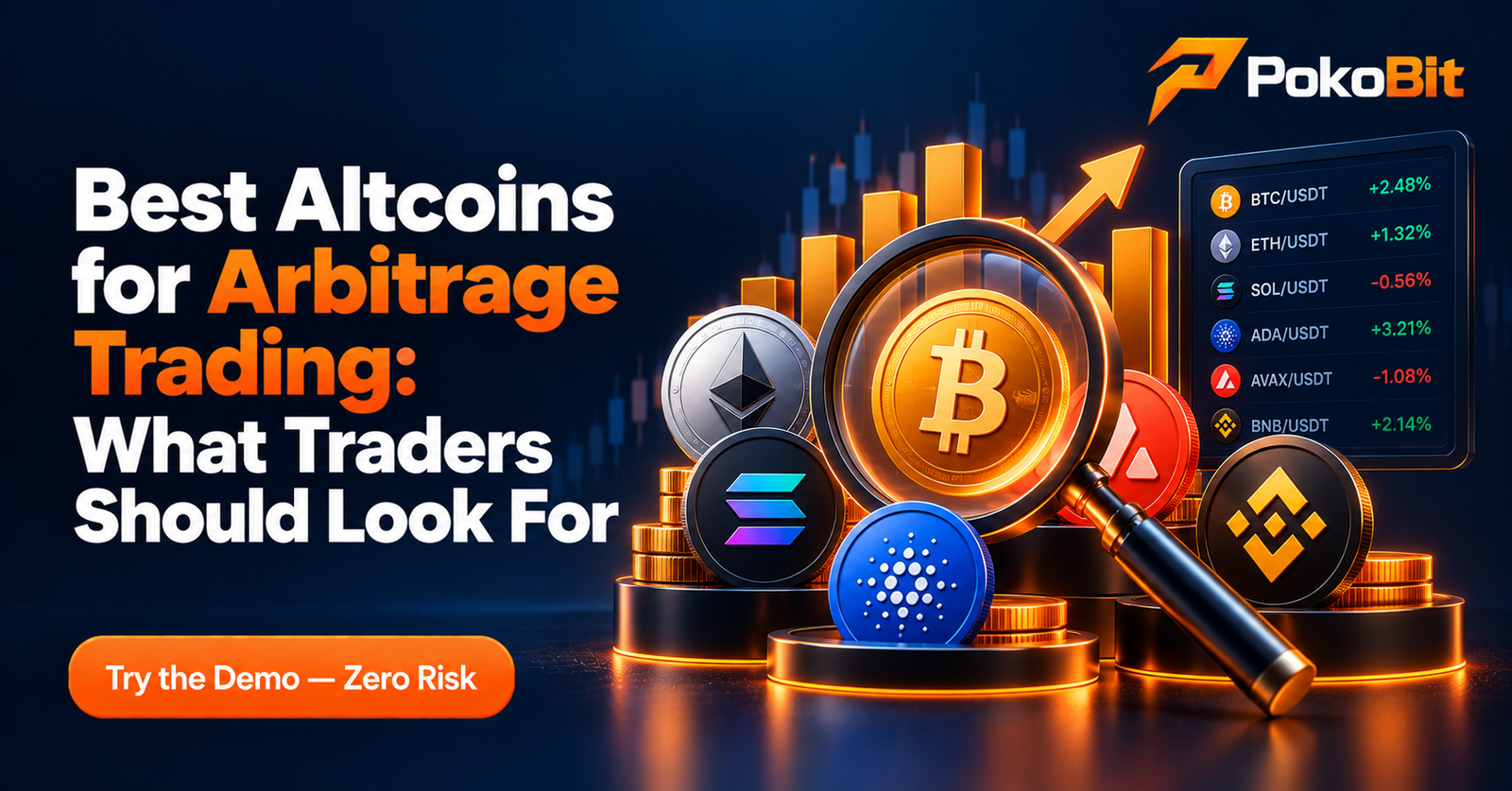
Best Altcoins for Arbitrage Trading
Choosing the best altcoins for arbitrage trading is not simply about finding cryptocurrencies with the biggest price differences.
For arbitrage, traders need markets where they can potentially buy and sell enough of an asset at competitive prices. Liquidity, trading volume, order-book depth, exchange availability, trading fees and execution speed can be more important than the size of the advertised spread.
Current market data illustrates why. CoinGecko’s 2026 liquidity research shows strong cross-exchange liquidity for assets such as XRP and SOL, while DOGE has noticeably shallower liquidity. Its current high-volume rankings also show substantial activity in assets including SOL, XRP, DOGE, HYPE, NEAR, UNI, ADA, AVAX, SUI and LINK.
These characteristics make several established altcoins worth monitoring for arbitrage—but they do not mean that any particular coin is guaranteed to produce profitable opportunities.
What Makes an Altcoin Good for Arbitrage?
Before choosing an altcoin, look at several important factors.
1. Liquidity
Liquidity is one of the most important factors.
A liquid market generally has enough buyers and sellers to allow trades without significantly moving the price. Poor liquidity can result in slippage, where the actual execution price becomes worse than the price initially displayed.
For arbitrage, this matters because you usually need to execute both sides of the strategy quickly.
2. Trading Volume
High trading volume can indicate strong market activity and more opportunities to enter and exit positions.
However, volume alone isn’t enough.
A market can have high reported volume but still have limited liquidity around the exact price where you want to execute.
Order-book depth should therefore be examined alongside volume.
3. Exchange Availability
An altcoin needs to be available on multiple exchanges for traditional cross-exchange arbitrage.
The more reputable markets that support the same trading pair, the more opportunities there may be to compare prices.
4. Tight Execution
The actual bid and ask prices matter more than the last traded price.
A potential arbitrage trade should be evaluated using the price at which you can realistically buy and sell.
5. Trading Costs
Trading fees can quickly reduce a small arbitrage spread.
A good opportunity should have enough spread to potentially cover:
- Buy-side fees
- Sell-side fees
- Slippage
- Withdrawal costs
- Network fees
- Other applicable expenses
Altcoins Worth Monitoring for Arbitrage
There is no permanent list of “best” arbitrage coins because liquidity, volume and exchange conditions change.
However, several established altcoins currently stand out as markets worth monitoring.
1. Solana (SOL)
Solana is one of the most actively traded altcoins and has substantial liquidity across major centralized exchanges.
CoinGecko’s 2026 liquidity report found that SOL had significant order-book depth across the exchanges studied, although its overall liquidity had declined from the previous year.
SOL can therefore be an interesting asset to monitor for cross-exchange arbitrage.
The important consideration is whether the available depth is sufficient for your particular trade size.
2. XRP
XRP is another major altcoin with significant trading activity.
CoinGecko’s 2026 liquidity research found XRP liquidity distributed across multiple major exchanges, with healthy liquidity at market price across the exchanges included in its study.
Its combination of trading activity and exchange availability can make XRP worth monitoring when searching for arbitrage opportunities.
3. Dogecoin (DOGE)
DOGE remains one of the most actively traded altcoins.
Current CoinGecko data places DOGE among the higher-volume cryptocurrencies, with more than $1 billion in reported 24-hour trading volume in the snapshot reviewed.
However, liquidity needs special attention.
CoinGecko’s 2026 liquidity research found DOGE had substantially shallower liquidity than SOL and XRP across the exchanges studied.
This means DOGE can be interesting to monitor, but traders should pay close attention to order-book depth and slippage.
4. Sui (SUI)
SUI is another altcoin with meaningful trading activity.
Current market-volume data places SUI among the more actively traded assets, while exchange research has also included SUI among significant trading pairs.
Because SUI trades across multiple markets, it can be worth monitoring for temporary price discrepancies.
However, traders should always verify current liquidity before executing a large position.
5. Avalanche (AVAX)
Avalanche is another established altcoin that appears among actively traded cryptocurrency markets.
Current CoinGecko data shows meaningful trading volume for AVAX, making it another asset that can be included in an arbitrage watchlist.
As with every altcoin, the relevant question is not simply whether AVAX has high volume, but whether there is sufficient cross-exchange depth at the prices you need.
6. Cardano (ADA)
ADA has broad exchange availability and continues to record substantial trading activity.
Current CoinGecko rankings place ADA among the higher-volume cryptocurrencies.
This makes it another candidate for monitoring, particularly when comparing the same ADA trading pair across several exchanges.
7. Chainlink (LINK)
LINK is another established altcoin with significant market activity.
Current market data shows hundreds of millions of dollars in reported 24-hour trading volume for LINK.
For arbitrage purposes, traders should focus on the liquidity available on the particular exchanges being compared rather than relying only on its overall market volume.
8. NEAR Protocol (NEAR)
NEAR is another asset that currently has substantial trading activity.
Current CoinGecko data places NEAR among the higher-volume cryptocurrencies, with hundreds of millions of dollars in reported 24-hour volume in the current snapshot.
That makes NEAR another potential candidate for an arbitrage monitoring list.
What About Ethereum?
Ethereum is technically an altcoin because it is not Bitcoin, and it is one of the most liquid cryptocurrency markets.
Current CoinGecko liquidity research shows ETH maintaining substantial order-book depth across major centralized exchanges, although its liquidity relative to BTC has declined from 2025 levels.
Because of its deep markets and broad exchange availability, ETH is often worth including when building an arbitrage watchlist.
The downside is that highly liquid assets can have relatively efficient pricing, meaning the available arbitrage spread may often be smaller.
Best Altcoins for Arbitrage: Quick Comparison
| Altcoin | Liquidity | Trading Activity | Arbitrage Watchlist |
| ETH | Very High | Very High | Strong |
| SOL | High | High | Strong |
| XRP | High | High | Strong |
| DOGE | Moderate | High | Worth Monitoring |
| SUI | Moderate/High | High | Worth Monitoring |
| AVAX | Moderate/High | High | Worth Monitoring |
| ADA | High | High | Worth Monitoring |
| LINK | High | High | Worth Monitoring |
| NEAR | Moderate/High | High | Worth Monitoring |
These categories are not permanent rankings. Market depth and trading activity change continuously.
Why the Biggest Spread Isn’t Always the Best Opportunity
Imagine two opportunities:
Coin A
Spread: 2.5%
Liquidity: Very low
Coin B
Spread: 0.8%
Liquidity: High
Coin A appears better because its spread is larger.
But suppose your order is large enough to move Coin A’s price significantly.
After slippage, the effective spread could fall from 2.5% to 0.4%.
Coin B may still provide a 0.7% effective spread because its order book is deeper.
This is why execution quality matters more than headline spread.
How to Find the Best Altcoin Arbitrage Opportunities
A practical process is:
Step 1: Build a Watchlist
Start with liquid altcoins such as ETH, SOL, XRP, ADA, LINK, SUI, AVAX, DOGE and NEAR.
Step 2: Compare Multiple Exchanges
Check the same trading pair across several exchanges.
Step 3: Compare Bid and Ask Prices
Don’t rely solely on the last traded price.
Step 4: Check Order-Book Depth
Determine whether enough liquidity exists for your intended trade size.
Step 5: Calculate the Gross Spread
Calculate the difference between the effective buying and selling prices.
Step 6: Deduct All Costs
Account for:
Trading fees + slippage + transfer costs + network fees + other applicable costs
Step 7: Calculate the Net Potential Result
Only after the costs are deducted should you decide whether the opportunity is worth further consideration.
Can Altcoin Arbitrage Be Automated?
Yes.
Traders can use arbitrage scanners and automated trading systems to monitor multiple altcoins and exchanges.
A scanner can compare prices and highlight potential discrepancies, while a trading bot can potentially execute predefined strategies through exchange APIs.
However, automation doesn’t eliminate risk.
Arbitrage opportunities can disappear quickly, and execution, liquidity and technical risks remain important. Binance’s current arbitrage guidance specifically identifies execution and liquidity risk as major concerns.
Final Thoughts
The best altcoins for arbitrage trading are generally not simply the coins with the biggest price movements.
For arbitrage, the more important characteristics are:
- Strong liquidity
- Healthy order-book depth
- Multiple exchange listings
- Consistent trading activity
- Reasonable trading fees
- Manageable slippage
- Reliable execution
Currently, ETH, SOL, XRP, DOGE, SUI, AVAX, ADA, LINK and NEAR are reasonable assets to include in an arbitrage watchlist based on their current market activity and/or liquidity characteristics. But the best opportunity can change from one exchange and one moment to another.
The key principle is simple:
Don’t choose an altcoin because it has the biggest spread. Choose the market where the spread can potentially survive real-world execution costs.
Explore PokoBit
Explore PokoBit for more crypto arbitrage strategies, market insights and cryptocurrency trading resources.
Frequently Asked Questions
What are the best altcoins for arbitrage trading?
There is no permanent best list. Currently, ETH, SOL, XRP, DOGE, SUI, AVAX, ADA, LINK and NEAR are among the altcoins worth monitoring because of their trading activity and/or liquidity.
Is a high-volume altcoin automatically good for arbitrage?
No. Trading volume is useful, but order-book depth and actual execution liquidity are also important.
Is SOL good for arbitrage trading?
SOL can be a strong candidate to monitor because it has significant trading activity and liquidity across major exchanges. However, traders still need to evaluate the specific exchange pair, spread, fees and order-book depth before executing.
Is DOGE good for arbitrage?
DOGE has significant trading volume, but its liquidity can be shallower than assets such as SOL and XRP. This can increase slippage for larger orders.
How much spread is needed for altcoin arbitrage?
There is no universal percentage. The required spread depends on trading fees, liquidity, slippage, transfer costs, trade size and execution speed.
Is altcoin arbitrage guaranteed to make money?
No. Arbitrage involves execution and liquidity risks, and an apparent spread can disappear before both sides of a trade are completed.