Crypto Arbitrage Fees in Nigeria Explained
Crypto arbitrage in Nigeria involves identifying price differences between cryptocurrency markets and evaluating whether those differences can potentially be captured after costs.
A trader may see that USDT, Bitcoin, or another cryptocurrency is available at a lower price on one platform and a higher price on another. But the visible price difference is only the beginning.
Trading fees, P2P fees, withdrawal charges, network costs, spreads, and slippage can all reduce the potential return.
Understanding these costs is therefore essential before evaluating a crypto arbitrage opportunity in Nigeria.
What Are Crypto Arbitrage Fees?
Crypto arbitrage fees are the different costs associated with buying, selling, transferring, and potentially rebalancing cryptocurrency during an arbitrage strategy.
Depending on the strategy, these can include:
- Trading fees
- P2P transaction fees
- Withdrawal fees
- Network fees
- Deposit fees
- Conversion costs
- Bid-ask spreads
- Slippage
- Currency conversion costs
Not every arbitrage trade will involve every fee.
For example, an arbitrage strategy using pre-funded balances on two exchanges may avoid the need to transfer cryptocurrency during every trade.
1. Trading Fees
Trading fees are among the first costs to consider.
When you buy or sell cryptocurrency on an exchange, the platform may charge a maker or taker fee.
For example, Bybit’s current published standard spot fee is 0.1% for both maker and taker orders, although its fee schedule can vary by product and account tier.
Suppose you buy ₦1,000,000 worth of cryptocurrency with a 0.1% trading fee.
The fee would be approximately:
₦1,000,000 × 0.1% = ₦1,000
If you also execute a sell transaction with a 0.1% fee, another ₦1,000 could be charged.
That means the two trading transactions could cost approximately ₦2,000, before considering other costs.
Always check the current fee schedule of the specific exchange you are using because rates can change.
2. P2P Fees in Nigeria
P2P trading can introduce a different fee structure.
For example, Bybit’s published NGN P2P fee schedule currently shows different maker rates depending on the advertiser level and transaction type, while some NGN P2P taker transactions may have a 0% platform fee. Payment providers can also charge separate fees depending on the payment method.
This means you should distinguish between:
Exchange/P2P platform fee
and
Payment-provider or banking cost.
A transaction advertised as having zero P2P fees does not necessarily mean there are zero costs involved.
3. Withdrawal Fees
Moving cryptocurrency from one exchange to another can involve a withdrawal fee.
For example, if an arbitrage strategy requires:
Exchange A → Blockchain network → Exchange B
the first exchange may charge a withdrawal fee.
The exact amount can depend on:
- Cryptocurrency
- Blockchain network
- Exchange
- Network conditions
- Withdrawal method
Bybit, for example, states that on-chain withdrawal fees depend on the selected coin and chain and are displayed during the withdrawal process.
Therefore, withdrawal costs should be checked before executing an arbitrage strategy.
4. Network Fees
Blockchain transactions may also involve network costs.
These costs can vary significantly depending on the network and its current conditions.
For example, transferring an asset using one blockchain may have a very different cost from transferring the same asset using another supported network.
This is particularly important when calculating small arbitrage spreads.
A 0.20% price difference may look attractive, but if network and withdrawal costs consume most of that difference, the opportunity may no longer be attractive.
5. Bid-Ask Spread
The price you see on an exchange isn’t necessarily the price you can buy and sell at simultaneously.
There is usually a difference between:
Bid: What buyers are willing to pay.
Ask: What sellers are willing to accept.
This difference is the bid-ask spread.
For arbitrage, you should compare the actual executable prices rather than simply comparing the last traded prices.
This becomes particularly important in Nigerian P2P markets, where prices can vary between individual advertisements and trading conditions.
6. Slippage
Slippage occurs when your actual execution price differs from the price you expected.
For example, you might see:
BTC = ₦150,000,000
but when attempting to purchase a large amount, there may not be enough liquidity at that exact price.
Your order could then execute across several price levels.
The average purchase price becomes higher.
The same can happen when selling.
This is why order-book liquidity and trade size matter when calculating arbitrage potential.
7. Currency Conversion Costs
Nigerian traders may encounter additional costs when moving between naira and cryptocurrency markets.
For example, an arbitrage strategy could involve:
NGN → USDT → BTC → USDT → NGN
Every conversion can introduce a spread or fee.
If the strategy involves multiple currencies, these conversion costs need to be included in the calculation.
8. Transfer Delays Can Also Cost Money
A cost doesn’t always appear as a visible fee.
Time itself can become a cost in crypto arbitrage.
Suppose:
Exchange A: BTC = ₦150 million
Exchange B: BTC = ₦151 million
You buy BTC on Exchange A and begin transferring it to Exchange B.
If the price difference disappears before the transfer completes, the expected arbitrage opportunity may no longer exist.
This is why some cross-exchange strategies maintain funds on both platforms and execute the buy and sell sides without waiting for a transfer.
However, holding funds on multiple exchanges creates additional custody and counterparty considerations.
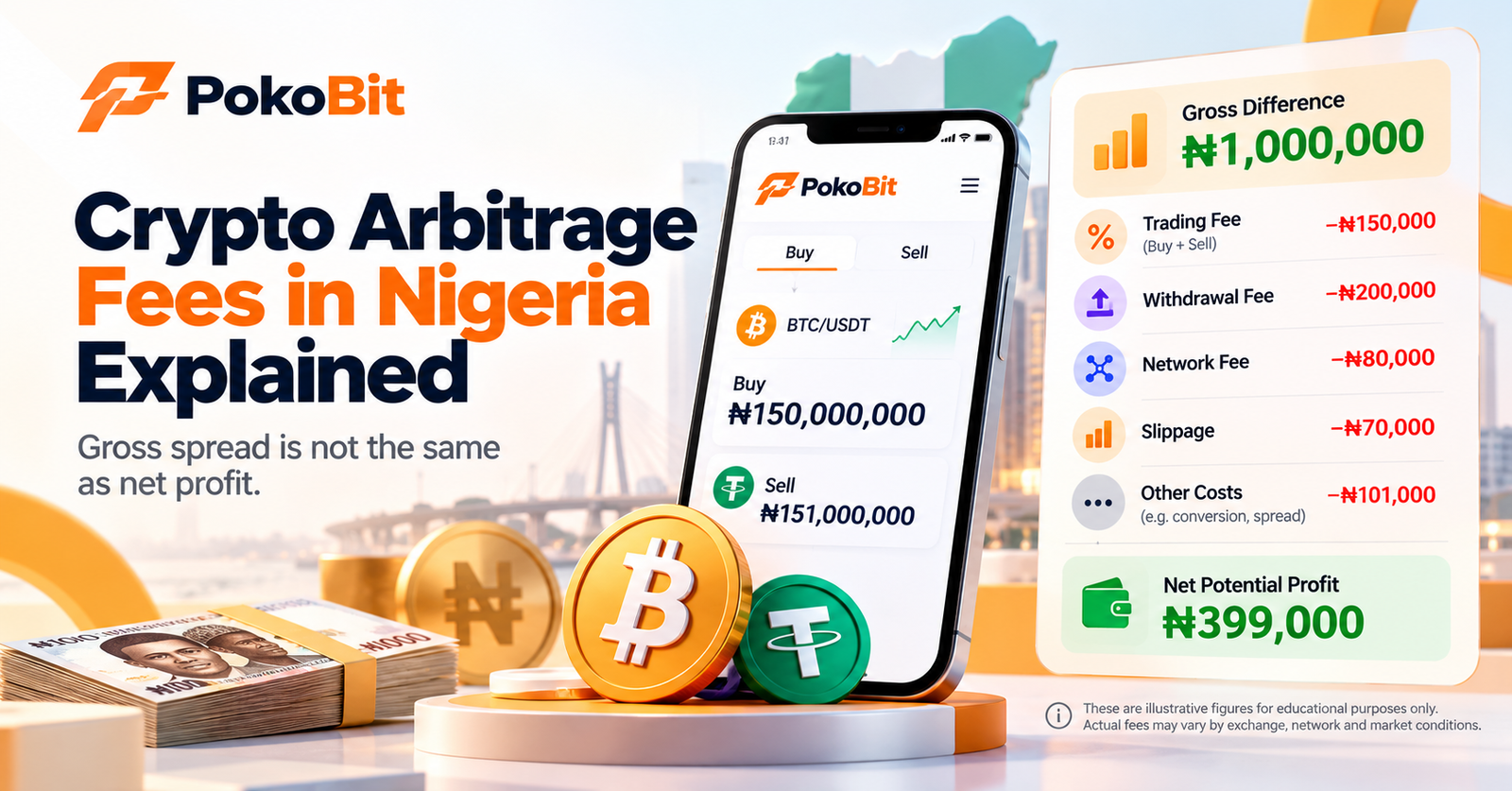
9. Example of Crypto Arbitrage Fees in Nigeria
Imagine you identify this opportunity:
Buy price: ₦150,000,000
Sell price: ₦151,000,000
Gross difference:
₦1,000,000
Now assume the following illustrative costs:
- Buy trading fee: ₦150,000
- Sell trading fee: ₦151,000
- Withdrawal/network costs: ₦100,000
- Slippage and other execution costs: ₦200,000
Total costs:
₦601,000
Remaining amount:
₦1,000,000 − ₦601,000 = ₦399,000
This is only an illustrative example, not a prediction of actual Nigerian exchange fees.
The important lesson is that a ₦1 million price difference does not mean ₦1 million of potential profit.
10. How to Calculate Net Arbitrage Potential
A simplified formula is:
Net Potential = Gross Spread − Trading Fees − P2P Fees − Withdrawal Costs − Network Costs − Slippage − Other Costs
For percentage calculations:
Net Spread % = Gross Spread % − Total Applicable Costs %
The exact calculation should reflect the specific exchanges, assets, trade size, payment methods, and networks being used.
Why Nigerian Crypto Arbitrage Can Be Different
The Nigerian crypto market has its own market structure, including NGN pricing, P2P markets, payment methods, liquidity conditions, and regulatory considerations.
Exchange availability can also change.
For example, Binance announced the discontinuation of its NGN services in 2024, including NGN spot pairs and NGN P2P trading.
Therefore, older articles or videos that recommend a particular NGN arbitrage route may no longer be accurate.
Nigeria’s digital-asset regulatory environment also continues to evolve, and the SEC maintains rules and registration frameworks covering areas of the digital-asset ecosystem.
Anyone operating a crypto business or service in Nigeria should verify the current regulatory requirements rather than relying on outdated information.
How to Reduce Crypto Arbitrage Costs
Traders evaluating arbitrage opportunities can consider:
- Comparing exchange fee schedules
- Checking current withdrawal costs
- Using appropriate blockchain networks
- Comparing bid and ask prices
- Checking order-book depth
- Avoiding extremely low-liquidity markets
- Calculating fees before executing
- Monitoring real-time spreads
- Considering pre-funded exchange balances
- Recalculating the opportunity immediately before execution
The objective isn’t necessarily to find the exchange with the lowest advertised fee.
It is to find the lowest total execution cost for the specific arbitrage strategy.
Final Thoughts
Crypto arbitrage fees in Nigeria can have a major impact on whether a price difference is actually useful.
The main costs to consider are:
- Trading fees
- P2P fees
- Withdrawal fees
- Network fees
- Bid-ask spreads
- Slippage
- Currency conversion costs
- Transfer-related costs
The most important rule is simple:
Never treat the displayed price difference as your actual profit.
Calculate the gross spread first, then subtract every relevant cost to determine the potential net result.
For traders analyzing opportunities with platforms such as PokoBit, this cost-based approach is much more useful than simply searching for the largest price difference.
FAQs
What fees should I consider when doing crypto arbitrage in Nigeria?
Consider trading fees, P2P fees, withdrawal fees, network costs, bid-ask spreads, slippage, and any currency conversion or payment-provider costs.
Are P2P crypto transactions free in Nigeria?
It depends on the platform, currency, transaction type, and participant role. Some platforms publish 0% fees for certain P2P transactions, while other transactions or payment methods can involve charges.
How do trading fees affect crypto arbitrage?
Fees are deducted from the spread. If the price difference is smaller than the combined execution costs, the arbitrage opportunity may no longer be attractive.
What is the biggest hidden cost in crypto arbitrage?
There isn’t one universal hidden cost. Slippage, liquidity limitations, transfer delays, and bid-ask spreads can all cause the actual result to differ from the displayed spread.
Can crypto arbitrage in Nigeria be profitable?
It can potentially produce positive returns when a price difference is large enough to cover all applicable costs, but profitability is not guaranteed. Market prices, fees, liquidity, and execution conditions can change quickly.