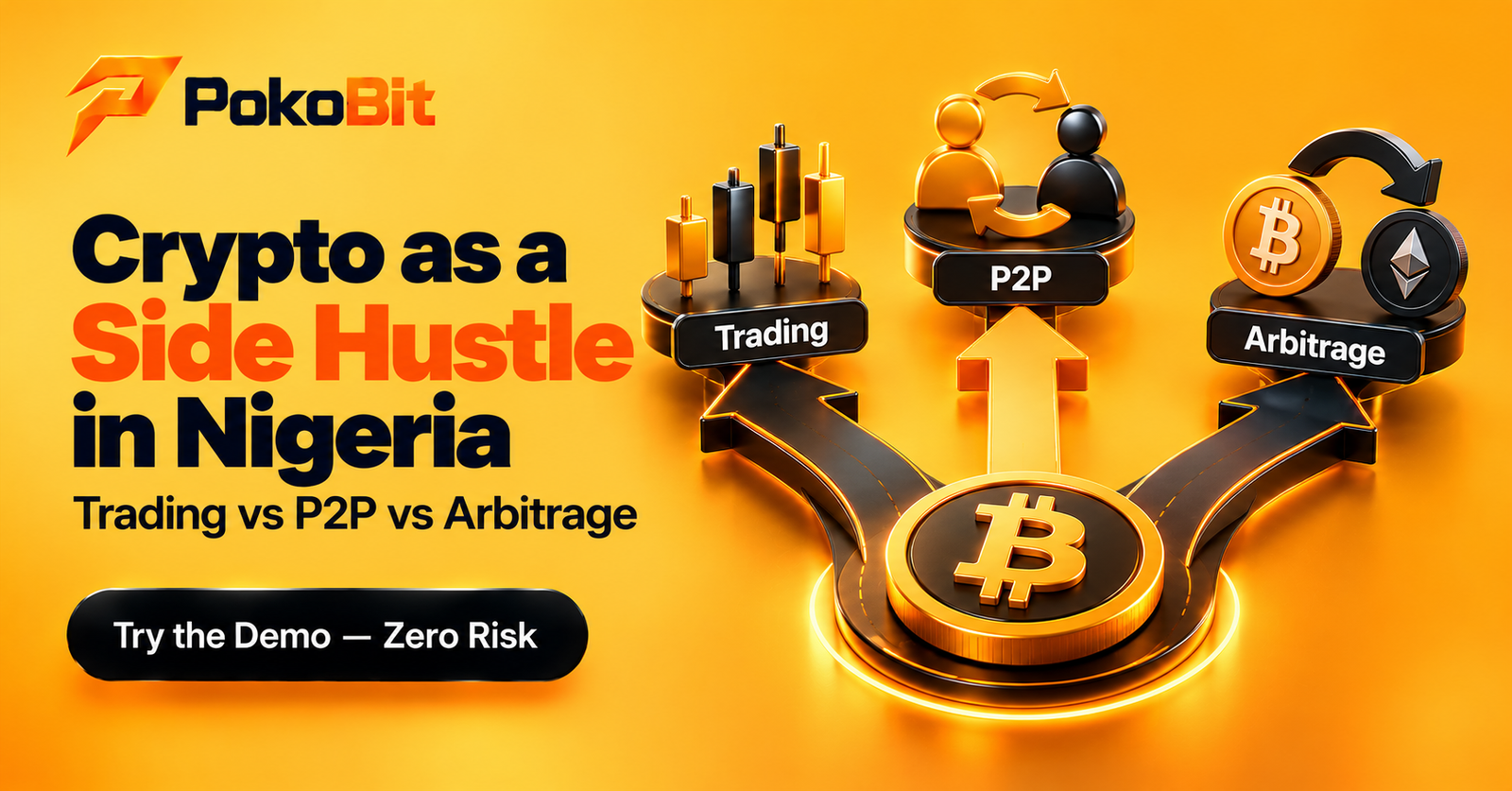
Crypto as a Side Hustle in Nigeria: Trading, P2P and Arbitrage Compared
Crypto has become an option Nigerians explore when looking for an additional source of income. However, not every crypto strategy works the same way. Some involve predicting price movements, others depend on buying and selling directly with other people, while arbitrage focuses on identifying price differences between markets.
If you are considering crypto as a side hustle in Nigeria, understanding these differences can help you choose a strategy that matches your available time, capital, experience and tolerance for risk.
This guide compares crypto trading, peer-to-peer (P2P) trading and arbitrage, including how each works, its advantages, limitations and the tools that can help you get started.
1. Crypto Trading: Buying and Selling Based on Price Movements
Crypto trading involves buying and selling digital assets such as Bitcoin, Ethereum and other cryptocurrencies to benefit from price changes.
For example, a trader might buy Bitcoin at $60,000 and sell it at $62,000. The difference is $2,000 per Bitcoin before trading fees and other costs. However, if the price falls instead, the trader may incur a loss.
How crypto trading works
Traders commonly use two approaches:
Spot trading: Buying an asset and selling it later at a higher price.
Futures trading: Taking positions on price movements using derivative contracts. Some futures products involve leverage, which can magnify both gains and losses.
Advantages
- You can trade without running a separate business or managing P2P transactions.
- Spot trading is relatively straightforward to understand.
- You can choose your trading frequency and the assets you follow.
Risks and limitations
Crypto prices can change rapidly. Successful trading requires market knowledge, risk management and emotional discipline. Frequent trading may also generate substantial fees, while leverage can lead to rapid losses or liquidation.
Crypto trading may suit someone willing to study market behaviour and monitor positions. It is not a reliable source of fixed daily income.
2. P2P Trading: Buying and Selling Crypto Directly With Other People
Peer-to-peer trading allows users to buy or sell cryptocurrency directly with other users through a platform that facilitates the transaction.
For example, a buyer may purchase USDT from a seller at an agreed price using a supported payment method. Another user might sell USDT at a different price depending on demand, payment methods and market conditions.
The difference between buying and selling prices can create a trading opportunity, but it does not automatically mean the transaction will be profitable.
How P2P trading works
A typical process involves:
- Comparing available offers and exchange rates.
- Checking the counterparty's reputation and transaction history.
- Confirming the payment method and transaction conditions.
- Completing payment and following the platform's release process.
- Recording the transaction value, fees and resulting margin.
Some traders complete individual transactions, while others operate more actively by maintaining liquidity and responding to changing market demand.
Advantages
- You can learn how crypto prices differ across payment methods and markets.
- There may be opportunities to earn a margin from buying and selling USDT.
- You can develop practical skills in pricing, transaction management and customer service.
Risks and limitations
P2P trading requires careful attention to payment confirmation, fraudulent payment claims, chargebacks where applicable, account restrictions and platform rules. Never release crypto based solely on a payment screenshot.
Your potential margin can also disappear because of transfer costs, changing exchange rates or delays. Check the rules of your chosen platform and payment provider before transacting.
For a deeper explanation, read What Is P2P Crypto Arbitrage? A Complete Guide.
3. Crypto Arbitrage: Comparing Prices Across Markets
Crypto arbitrage involves identifying price differences for the same asset across markets or related trading instruments.
For example, suppose USDT is available for $1.00 on one market and can be sold for $1.02 on another. The apparent spread is $0.02 per USDT. Before treating this as an opportunity, you must account for trading fees, transfer costs, liquidity, execution delays and any difference between the quoted and executable prices.
Arbitrage is not simply buying low and selling high. The challenge is determining whether the price difference can actually be captured after costs.
Common types of crypto arbitrage
Cross-exchange arbitrage: Comparing the price of an asset on two cryptocurrency exchanges.
P2P arbitrage: Identifying price differences between P2P offers or markets.
Spot-futures arbitrage: Taking offsetting positions in spot and futures markets when their prices diverge.
Funding-rate arbitrage: Using suitable spot and perpetual futures positions to seek funding payments while managing the risks of both positions.
Learn more about how crypto arbitrage works in Nigeria.
Advantages
- The strategy focuses on price differences rather than relying only on predicting whether the market will rise or fall.
- Price comparison can be systematic and supported by analytical tools.
- Experienced users can explore different markets and strategies based on their resources.
Risks and limitations
An apparent spread is not guaranteed profit. Prices may change before orders execute, available liquidity may be insufficient, transfers may be delayed, and fees can eliminate the margin.
Arbitrage can also require funds on multiple exchanges or accounts. Some strategies involve derivatives, funding payments and additional liquidation or counterparty risks.
A scanner can help identify possible opportunities, but it cannot remove these risks or guarantee that an opportunity will remain profitable.
4. Trading vs P2P vs Arbitrage: Which Is Better as a Side Hustle?
| Factor Crypto trading P2P trading Crypto arbitrage | |||
| Main approach | Trading price movements | Buying and selling directly with users | Exploiting price differences |
| Key skill | Market analysis and risk management | Pricing, transaction handling and verification | Price comparison, cost analysis and execution |
| Time requirement | Depends on trading style | Can require frequent transaction monitoring | Depends on strategy and execution speed |
| Main risks | Volatility and poor decisions | Fraud, payment disputes and price changes | Fees, execution delays and disappearing spreads |
| Tools | Charts and trading platforms | P2P marketplaces and records | Exchange comparisons and arbitrage scanners |
| Income certainty | Not guaranteed | Not guaranteed | Not guaranteed |
There is no universally best option. Your choice should depend on your experience, available capital, time commitment and ability to manage losses.
A beginner who prefers learning market analysis may start by studying spot trading. Someone comfortable managing transactions may explore P2P trading. Someone interested in systematic price comparison may study arbitrage.
In every case, start with education and small, affordable amounts rather than money needed for essential expenses.
5. How PokoBit Can Help With Arbitrage Research
Comparing prices manually across multiple markets can be time-consuming. PokoBit is designed to help users explore crypto arbitrage opportunities through its platform and scanner-focused workflow.
Instead of assuming that every price difference represents profit, use a structured process:
- Identify a potential price difference.
- Confirm the available buy and sell prices.
- Check liquidity and order-book depth.
- Calculate trading fees, transfer costs and other expenses.
- Assess execution risks before committing funds.
- Record the result and review whether the strategy is viable.
You can explore the PokoBit platform and review the available features before deciding whether they suit your needs.
If you are new to arbitrage, you can also create a PokoBit account to explore the advertised 10,000 USDT demo account without a card. Check the current demo terms and available functionality before relying on them.
For educational updates and community discussions, visit the official PokoBit Telegram community.
6. Important Considerations for Nigerian Crypto Users
Before making crypto part of your side hustle, consider the following:
- Capital: Never use rent, school fees, emergency savings or borrowed money you cannot afford to lose.
- Record keeping: Track deposits, withdrawals, transaction costs, realised gains and losses.
- Security: Use strong authentication, protect recovery phrases and verify wallet addresses before transfers.
- Compliance: Check applicable Nigerian laws, tax obligations, platform terms and payment-provider rules. Nigeria's virtual-asset regulatory and tax framework continues to evolve. The Joint Revenue Board's guidance on taxation of virtual assets is a useful official starting point.
- Scams: Avoid anyone promising fixed daily returns, guaranteed arbitrage profits or risk-free crypto income.
A side hustle should be approached as an activity that requires learning, monitoring and careful financial decisions, not as guaranteed income.
Conclusion
Crypto trading, P2P trading and arbitrage offer different ways to participate in digital-asset markets, but each comes with its own learning curve and risks.
Trading focuses on price movements. P2P trading involves direct transactions between users. Arbitrage focuses on price differences across markets or instruments and requires careful calculation of costs and execution risks.
The right starting point is to understand the strategy before committing money. Learn the mechanics, practise where suitable, keep accurate records and never assume that an advertised spread equals a realised profit.
If you want to explore price comparison and arbitrage research, visit PokoBit and join the PokoBit Telegram community for updates and discussions.
Frequently Asked Questions
Can I make money from crypto as a side hustle in Nigeria?
It is possible to make gains through crypto trading, P2P trading or arbitrage, but losses are also possible. Results depend on market conditions, costs, execution, skill and risk management. None of these methods guarantees income.
Which is easier for a beginner: trading, P2P or arbitrage?
Spot trading may be easier to understand initially, while P2P trading requires careful transaction handling. Arbitrage requires additional understanding of price spreads, liquidity, fees and execution. The easiest option depends on your skills and circumstances.
How much money do I need to start crypto arbitrage?
There is no universal minimum. Requirements depend on the exchanges, assets, fees and strategy involved. Small capital may limit the size of available opportunities, and transaction costs can consume a larger share of small trades. Calculate your costs before starting.
Is crypto arbitrage risk-free?
No. Price differences can disappear, transfers can be delayed, orders may execute at worse prices, and fees can turn an apparent opportunity into a loss. A scanner identifies potential opportunities; it does not guarantee profitable execution.
Is crypto legal in Nigeria?
Nigeria has an evolving framework for virtual assets, including regulatory and tax requirements. The obligations depend on the activity and the parties involved. Review current official guidance and obtain qualified advice where necessary before operating a crypto-related business or making tax decisions.