USDT Arbitrage Bot Explained
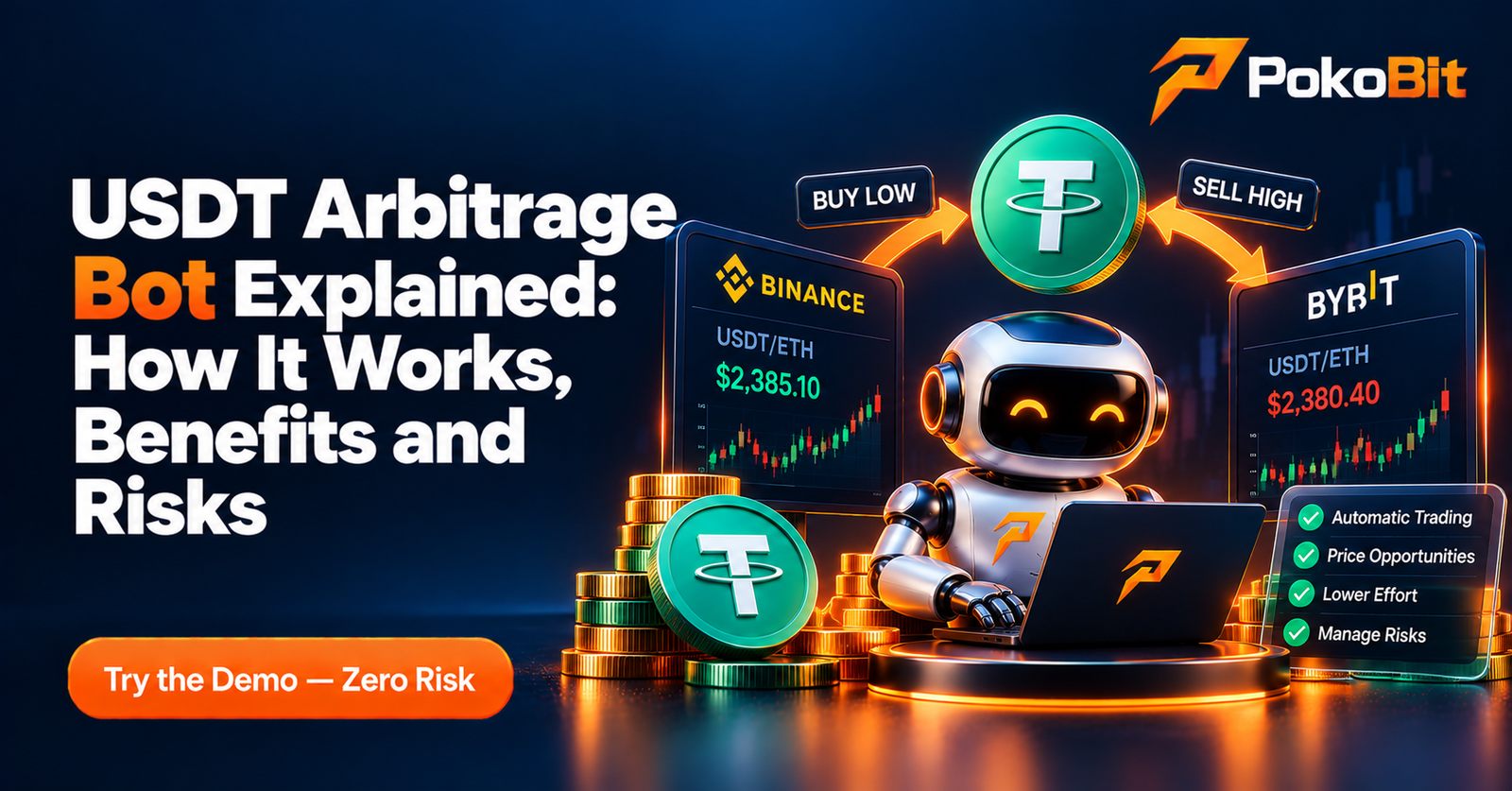
A USDT arbitrage bot is software designed to automatically monitor cryptocurrency markets for price differences involving USDT and, depending on its configuration, execute trades when predefined conditions are met.
The basic idea behind crypto arbitrage is simple: buy an asset at a lower price in one market and sell it at a higher price in another. The challenge is that these price differences can disappear very quickly. Automated systems can monitor multiple markets and react much faster than manual trading.
However, an arbitrage bot does not guarantee profit. Trading fees, slippage, liquidity, execution delays, API problems, and changing prices can turn an apparently profitable opportunity into a loss.
What Is a USDT Arbitrage Bot?
A USDT arbitrage bot is an automated trading program that searches for price discrepancies involving USDT trading pairs.
For example, suppose BTC is available at:
Exchange A: 100,000 USDT
Exchange B: 100,800 USDT
The bot could identify the difference and determine whether buying BTC on Exchange A and selling it on Exchange B could potentially produce a positive result after costs.
Depending on the bot, it may simply generate alerts or go further and automatically place orders through exchange APIs.
How Does a USDT Arbitrage Bot Work?
A typical arbitrage bot follows several steps.
1. Connects to Exchange Data
The bot connects to supported cryptocurrency exchanges, usually through APIs.
APIs allow software to communicate directly with an exchange and retrieve information such as prices, balances, order status, and other market data. Trading automation platforms can also use APIs to send trade instructions.
2. Monitors Multiple Markets
The bot continuously checks selected trading pairs.
For example, it could monitor:
- BTC/USDT
- ETH/USDT
- SOL/USDT
- XRP/USDT
- Other supported USDT pairs
The more markets a system monitors, the more potential price differences it can identify.
3. Calculates the Spread
The bot compares the available prices.
For example:
Buy: 100,000 USDT
Sell: 100,700 USDT
The gross difference is 700 USDT.
But the bot should not treat the entire 700 USDT as profit.
It needs to consider trading fees and execution costs before deciding whether the opportunity meets its requirements.
4. Checks the Profit Threshold
A trader might configure a bot to act only when the estimated net return exceeds a particular threshold.
For example:
Execute only when estimated net profit is greater than 0.5%.
This can prevent the bot from taking trades where the spread is too small to cover costs.
5. Executes the Trade
If the opportunity meets the bot’s conditions, it can submit buy and sell orders through the connected exchanges.
Speed is important because arbitrage spreads can close quickly as other market participants act on the same opportunity.
Example of USDT Arbitrage With a Bot
Imagine a bot detects the following:
Exchange A
BTC price: 100,000 USDT
Exchange B
BTC price: 100,900 USDT
The gross difference is:
900 USDT
If the trader is using 10,000 USDT, the theoretical gross spread would be approximately 90 USDT before fees and other costs.
The bot would then need to consider:
- Exchange trading fees
- Bid/ask spread
- Slippage
- Available liquidity
- Network costs where applicable
- Transfer costs
- Execution delays
If those costs total 40 USDT, the theoretical remaining amount would be around 50 USDT before any additional execution effects.
This demonstrates why gross spread and actual potential profit are not the same thing.
Why Use a USDT Arbitrage Bot?
Faster Execution
A bot can react to market data much faster than manually checking multiple exchanges.
24/7 Monitoring
Crypto markets operate continuously, meaning opportunities can appear at any time. Automated software can monitor markets without requiring the trader to remain at a screen.
Multiple Exchange Monitoring
Instead of manually comparing prices across several platforms, a bot can monitor multiple markets simultaneously.
Consistent Rules
A bot can follow predefined conditions instead of changing its strategy based on emotions.
Automated Order Management
Depending on its design and permissions, a bot can submit and monitor orders automatically through exchange APIs.
USDT Arbitrage Bot vs Manual Arbitrage
| Feature | Manual Arbitrage | USDT Arbitrage Bot |
| Price monitoring | Manual | Automated |
| Multiple exchanges | Difficult to monitor | Easier |
| Speed | Slower | Faster |
| Alerts | Manual | Automated |
| Trade execution | Manual | Can be automated |
| 24/7 monitoring | Difficult | Possible |
| Strategy rules | Human-controlled | Programmed |
| Technical risk | Lower | Higher |
Automation provides speed and convenience, but it also introduces software, API, connectivity, and configuration risks.
What Makes a Good USDT Arbitrage Bot?
Not every trading bot is designed equally.
Important features to consider include:
Real-Time Market Data
The bot should use timely market information. Outdated prices can cause false opportunities.
Multiple Exchange Support
A useful cross-exchange bot should support the exchanges relevant to the trader’s strategy.
Fee Calculation
The bot should account for trading fees instead of treating every price difference as profit.
Liquidity Analysis
A displayed price may not be available for the entire order size. Low liquidity can increase price impact and slippage.
Risk Controls
Useful controls can include maximum trade sizes, minimum profit thresholds, order limits, and emergency shutdown mechanisms.
Secure API Connections
API permissions should be carefully configured. Where an exchange allows it, traders should avoid granting unnecessary withdrawal permissions to third-party trading software.
Risks of Using a USDT Arbitrage Bot
Automation does not eliminate trading risk.
Price Movement
The price can change between opportunity detection and execution.
Slippage
Slippage occurs when an order executes at a different price than expected. Low liquidity can make slippage worse.
Trading Fees
Even relatively small fees can significantly reduce the return from frequent arbitrage trades. Exchange fee structures can vary by platform, trading volume, order type, and account tier.
API Failures
An exchange API could become unavailable, delayed, rate-limited, or return an error.
Software Bugs
A poorly designed bot can place incorrect orders or behave differently from what the trader intended.
Security Risk
Connecting an automated system to an exchange account creates an additional security consideration. API credentials should be protected carefully, and traders should understand exactly what permissions a bot receives.
Can a USDT Arbitrage Bot Guarantee Profit?
No.
A bot can automate a strategy, but it cannot guarantee that every detected opportunity will be profitable.
Crypto arbitrage depends heavily on execution. A spread may disappear before both sides of the trade are completed, while fees and slippage can reduce the expected return.
Professional arbitrage systems therefore focus not only on finding price differences but also on execution speed, liquidity, costs, and risk controls.
Final Thoughts
A USDT arbitrage bot can automate much of the work involved in monitoring crypto markets and executing arbitrage strategies.
Its biggest advantage is speed. Instead of manually checking different exchanges, a bot can continuously compare markets and respond when predefined conditions are met.
But automation should not be confused with guaranteed profitability. The most important factors remain net spread, trading fees, liquidity, slippage, execution speed, API reliability, and risk management.
For anyone researching crypto arbitrage, understanding how the bot works is just as important as finding an opportunity.
Explore PokoBit
Explore PokoBit to learn more about crypto arbitrage, automated trading strategies, and cryptocurrency market opportunities.
Frequently Asked Questions
What is a USDT arbitrage bot?
A USDT arbitrage bot is automated software that monitors cryptocurrency markets for price differences involving USDT and may execute trades according to predefined rules.
How does a USDT arbitrage bot make money?
It attempts to buy an asset at a lower effective price and sell it at a higher effective price. The potential result depends on the spread remaining after trading fees, slippage, liquidity and other applicable costs.
Are USDT arbitrage bots profitable?
They can potentially identify and execute profitable opportunities, but profitability is not guaranteed. Market conditions and execution costs can change quickly.
Do arbitrage bots need exchange APIs?
Many automated arbitrage systems use exchange APIs to obtain market data, check balances, and place orders. API permissions and security should be carefully managed.
Is automated crypto arbitrage risk-free?
No. Automated arbitrage still involves market, liquidity, execution, technical, API, security, and fee-related risks.