
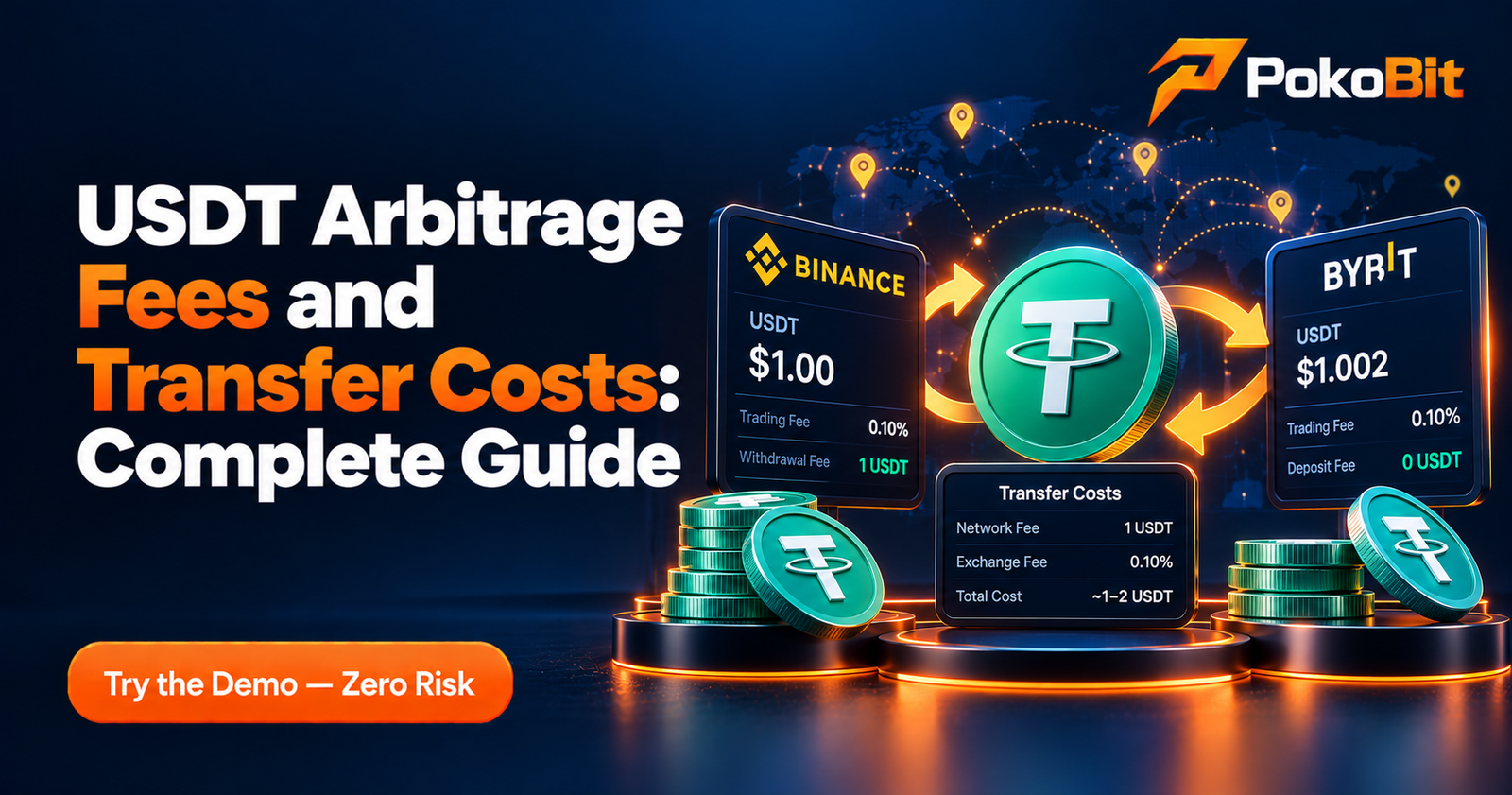
USDT Arbitrage Fees and Transfer Costs
USDT arbitrage involves taking advantage of price differences between cryptocurrency markets. A trader may buy USDT or another crypto asset at a lower effective price in one market and sell it at a higher effective price somewhere else.
But the difference between the two prices is not automatically your profit.
Trading fees, withdrawal charges, network fees, slippage and other transfer costs can reduce the spread significantly. In some situations, these costs can eliminate the opportunity entirely.
Understanding these costs is therefore essential before executing a USDT arbitrage trade.
What Fees Are Involved in USDT Arbitrage?
Depending on the strategy, USDT arbitrage can involve several different costs.
The most important ones are:
- Trading fees
- Withdrawal fees
- Network fees
- Deposit fees
- Slippage
- Currency conversion costs
- Rebalancing costs
- Funding costs for certain futures strategies
Not every arbitrage trade will involve all of these expenses, but they should be considered when calculating the potential return.
USDT Trading Fees
Trading fees are charged when you buy or sell cryptocurrency on an exchange.
Depending on the platform, fees can vary according to:
- Maker or taker status
- Trading volume
- Account level
- Trading pair
- Exchange
- Regional fee structure
For example, current published Nigerian USDT/NGN order-book examples show how fees can differ between venues: Daya Pro lists 0% taker and 0.05% maker fees, while Quidax lists 0.1% taker and 0.07% maker fees for USDT/NGN. These rates can change, so traders should verify the applicable fee before executing a trade.
Why Trading Fees Matter
Suppose your gross arbitrage spread is 1%.
If the combined cost of buying and selling is 0.4%, your remaining margin is already reduced to approximately 0.6% before considering other costs.
The calculation becomes even more important when executing many small trades.
USDT Withdrawal Fees
Withdrawal fees are another important cost.
When USDT or another cryptocurrency is moved from one exchange to another, the exchange may charge a withdrawal fee.
The fee can be:
- Fixed in USDT
- Fixed in another asset
- Network-dependent
- Variable according to the exchange
For example, some exchanges publish different withdrawal costs depending on the blockchain network selected. Current fee information can change, so the withdrawal screen should always be checked immediately before sending funds.
A fixed withdrawal fee has a much bigger effect on a small transfer than a large one.
For example:
$2 withdrawal fee on $100 = 2%
But:
$2 withdrawal fee on $10,000 = 0.02%
This is why trade size matters when evaluating USDT arbitrage.
USDT Network Fees
The blockchain network used to transfer USDT can also affect the total cost.
USDT is available on multiple networks, including networks such as:
- Tron
- Ethereum
- BNB Smart Chain
- Solana
- Arbitrum
- Polygon
- Other supported networks
The cost can vary significantly between networks and can also change with network conditions.
More importantly, the sending and receiving platforms must support the same network. Sending USDT using an unsupported network can create serious problems.
Network fees and exchange withdrawal fees are also not necessarily the same thing. An exchange may charge its own withdrawal fee while also accounting for the underlying network cost.
USDT Transfer Costs in Arbitrage
Transfer costs become especially important in cross-exchange arbitrage.
Consider this example:
You purchase USDT or another cryptocurrency on Exchange A and need to move it to Exchange B to sell at the higher price.
Your potential profit depends partly on how much value remains after the transfer.
For example:
Gross arbitrage spread: $100
Trading fees: −$20
Withdrawal fee: −$10
Network/transfer cost: −$5
Estimated slippage: −$15
Potential remaining amount: $50
The original $100 spread has effectively become a $50 potential margin before considering further price movement.
This is why arbitrage calculations should always focus on the net result, not simply the visible price difference.
Slippage Is Also a Cost
Slippage occurs when the actual execution price differs from the expected price.
For example, a trader may see an asset available at a particular price, but the available liquidity at that price may not be sufficient for the entire order.
The remaining portion of the order may therefore execute at less favorable prices.
This can be particularly important for large arbitrage trades and markets with limited liquidity.
A scanner showing a 1.5% spread does not necessarily mean you can execute the entire trade at a 1.5% spread.
Example of USDT Arbitrage Costs
Imagine you identify the following opportunity:
Capital: $5,000
Gross arbitrage spread: 1.5%
The theoretical gross difference is:
$5,000 × 1.5% = $75
Now assume:
Buy-side fee: $10
Sell-side fee: $10
Withdrawal/transfer cost: $8
Estimated slippage: $12
Total estimated costs:
$40
Potential remaining amount:
$75 − $40 = $35
So although the original spread appeared to be worth $75, the estimated amount remaining after these costs is only $35.
And even that is not guaranteed because prices can change while the trade is being executed.
How to Calculate Net USDT Arbitrage Profit
A simple calculation is:
Net Profit = Gross Spread − Trading Fees − Withdrawal Fees − Network Costs − Slippage − Other Costs
For percentage calculations:
Net Return = Net Profit ÷ Capital Used × 100
This is much more useful than looking only at the displayed spread.
How to Reduce USDT Arbitrage Costs
Traders looking to improve their arbitrage economics can consider several approaches.
Compare Exchange Fees
Don’t assume every exchange charges the same amount.
Choose the Appropriate Network
When transferring USDT, use a network supported by both sides and compare the current costs.
Consider Trade Size
Fixed withdrawal fees become proportionally smaller as the transfer size increases.
Monitor Liquidity
Higher liquidity can help reduce the impact of large orders.
Avoid Unnecessary Transfers
Some arbitrage strategies use pre-funded balances across exchanges, reducing the need to transfer assets after every opportunity. This does not make arbitrage free, because trading costs, rebalancing and custody considerations still exist.
Calculate Before Executing
Always estimate the complete route before placing the trade.
Why Transfer Speed Matters
Transfer costs aren’t the only concern.
Time is also important.
If an arbitrage opportunity requires moving USDT between exchanges, the price difference could disappear before the transfer is completed.
This creates a major distinction between:
Gross opportunity
and
Executable opportunity
A spread may exist on the screen but no longer exist by the time your funds arrive and your second trade is executed.
Final Thoughts
USDT arbitrage fees and transfer costs can have a major impact on the profitability of an arbitrage strategy.
The most important lesson is simple:
Don’t calculate arbitrage profit from the spread alone.
Always consider trading fees, withdrawal charges, network costs, slippage, liquidity and transfer timing.
A 2% price difference may look attractive, but the actual net result could be considerably smaller after all applicable costs.
The strongest arbitrage analysis is therefore based on real executable prices and net potential profit, not just the largest percentage displayed by an exchange or scanner.
Explore PokoBit
Learn more about crypto arbitrage, trading strategies and cryptocurrency market opportunities with PokoBit.
Frequently Asked Questions
What are the main fees in USDT arbitrage?
The main costs can include trading fees, withdrawal fees, network charges, slippage, conversion costs and rebalancing expenses.
Are USDT transfer fees always the same?
No. They can vary depending on the exchange, blockchain network, withdrawal conditions and other factors. Always check the current fee before transferring funds.
Can transfer fees eliminate arbitrage profit?
Yes. If the arbitrage spread is small, trading and transfer costs can consume most or all of the potential margin.
Which network is cheapest for USDT transfers?
There is no permanent cheapest network. Costs can vary by network conditions and, importantly, by the withdrawal fee charged by the exchange. Compare the actual total cost shown by the sending exchange before transferring.
Should I transfer USDT for every arbitrage opportunity?
Not necessarily. Depending on the strategy, maintaining balances on multiple exchanges can reduce the need for frequent transfers. However, this introduces capital allocation and exchange-custody considerations.
What is more important: spread or net profit?
Net potential profit is more important. A large gross spread is not useful if fees, slippage, liquidity and transfer costs consume the majority of it.