USDT Arbitrage Scanner Explained
USDT arbitrage involves looking for price differences between cryptocurrency markets where USDT is used as the trading currency. Because crypto markets operate continuously and prices can vary between exchanges, traders may find situations where an asset is available at a lower price on one platform and a higher price on another.
The challenge is finding these opportunities quickly and determining whether they are actually profitable.
This is where a USDT arbitrage scanner can help.
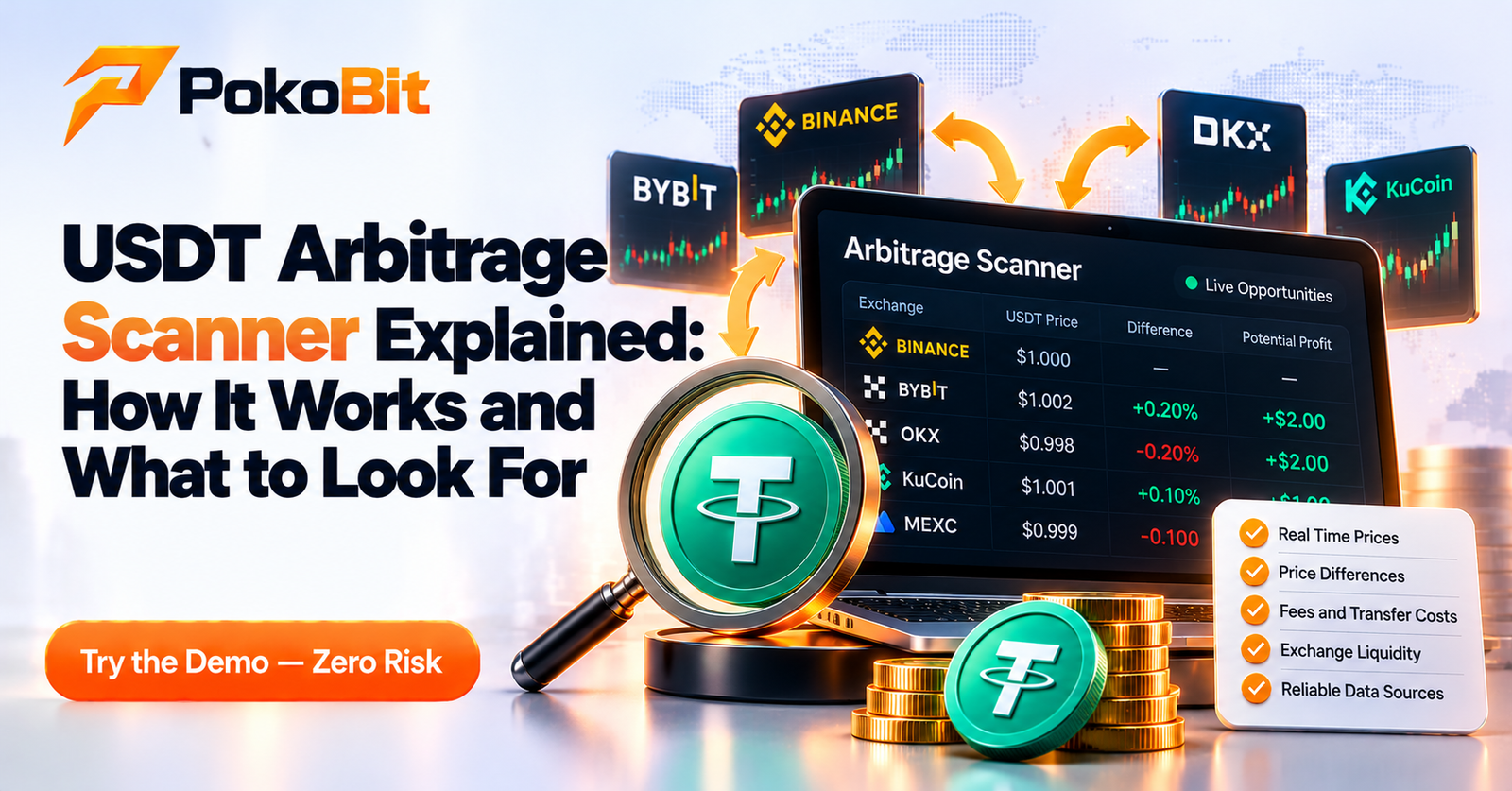
A USDT arbitrage scanner automatically monitors multiple cryptocurrency markets and looks for price differences that could potentially create arbitrage opportunities.
However, finding a price difference does not automatically mean there is guaranteed profit. Trading fees, liquidity, slippage, transfer costs, and execution speed can all affect the final result.
What Is a USDT Arbitrage Scanner?
A USDT arbitrage scanner is a software tool that monitors cryptocurrency exchanges and compares prices involving USDT.
For example, imagine that a cryptocurrency is trading at:
Exchange A: $100.00
Exchange B: $101.20
The scanner could identify the $1.20 difference and flag it as a potential arbitrage opportunity.
The trader would then need to check whether the difference is large enough to cover all applicable costs.
The main purpose of the scanner is therefore to save time by automatically comparing markets instead of requiring the trader to manually check multiple exchanges.
How Does a USDT Arbitrage Scanner Work?
A typical scanner works through several stages.
1. Collecting Market Data
The scanner connects to supported cryptocurrency exchanges and collects market information such as:
- USDT prices
- Bid and ask prices
- Trading pairs
- Order-book data
- Trading volume
- Available liquidity
The quality and speed of this data are important because crypto prices can change quickly.
2. Comparing Prices
The scanner compares prices across different exchanges.
For example:
Exchange A: BTC = 100,000 USDT
Exchange B: BTC = 100,800 USDT
The scanner detects the difference and may display it as a potential opportunity.
3. Calculating the Spread
The basic spread can be calculated as:
Spread = Selling Price − Buying Price
If BTC can theoretically be bought for 100,000 USDT and sold for 100,800 USDT, the gross price difference is 800 USDT.
But the gross spread is not the same as actual profit.
4. Considering Trading Costs
A useful scanner should help traders consider costs such as:
- Trading fees
- Slippage
- Withdrawal fees
- Network fees
- Conversion costs
- Other exchange charges
This is important because a seemingly attractive spread can become unprofitable after costs.
5. Sending an Alert
Some scanners can notify users when a particular spread reaches a chosen threshold.
For example, a trader could set a minimum spread requirement and receive an alert when the scanner detects a potential opportunity above that level.
What Should a USDT Arbitrage Scanner Show?
A useful scanner should provide more information than simply displaying two different prices.
Exchange Prices
The scanner should clearly show the relevant buy and sell prices.
Trading Pair
It should identify the specific trading pair, such as BTC/USDT or ETH/USDT.
Spread Percentage
The scanner may display the price difference as a percentage.
For example:
Buy Price: $100
Sell Price: $101
Gross Spread: 1%
Remember that the 1% figure represents the gross spread, not necessarily the final profit.
Liquidity
Liquidity is extremely important.
If there is insufficient liquidity at the displayed price, a large order may be filled at progressively worse prices.
Order-Book Depth
Order-book depth helps traders understand how much can realistically be bought or sold near the displayed price.
Fees
The scanner should ideally allow traders to account for the trading fees charged by the relevant exchanges.
Slippage
Slippage occurs when the actual execution price differs from the expected price.
A scanner that ignores slippage can make opportunities appear more profitable than they really are.
Example of a USDT Arbitrage Opportunity
Suppose a scanner identifies the following:
Exchange A
Buy price: $99.80
Exchange B
Sell price: $100.50
The gross difference is:
$100.50 − $99.80 = $0.70
If the trader uses $10,000, the theoretical gross spread would be approximately $70 before costs.
But the trader still needs to consider trading fees, slippage, network costs, withdrawal fees, and other expenses.
If total costs were $45, only $25 would remain before considering any additional execution issues.
This demonstrates why traders should focus on net potential profit rather than the displayed spread alone.
USDT Arbitrage Without Transferring Funds
Some traders maintain funds on multiple exchanges rather than transferring assets after every opportunity.
For example, a trader might hold USDT on one exchange and the relevant cryptocurrency on another.
When an opportunity appears, the trader can potentially buy on one platform while selling on another.
This approach can reduce dependence on blockchain transfer times, but it also means capital must be distributed across multiple platforms.
The trader also needs to consider exchange risk and whether maintaining balances across several platforms is appropriate for their strategy.
Why Speed Matters in USDT Arbitrage
Crypto arbitrage opportunities can disappear quickly.
When traders notice a price difference, buying activity on the cheaper exchange and selling activity on the more expensive exchange can cause the prices to move closer together.
This means an opportunity visible on a scanner may no longer exist by the time the trader attempts to execute it.
For this reason, data speed, exchange connectivity, liquidity, and execution quality are important when evaluating an arbitrage scanner.
How to Choose a USDT Arbitrage Scanner
Before relying on a scanner, consider these features:
Exchange coverage: Does it monitor the exchanges you use?
Data speed: How quickly does it update prices?
Liquidity information: Does it show order-book depth?
Fee calculations: Can it account for your trading fees?
Slippage analysis: Does it estimate the effect of your order size?
Alerts: Can it notify you when an opportunity appears?
API connectivity: Can it connect to supported exchange APIs?
Security: Does it require API credentials, and what permissions does it request?
A scanner that only displays the highest and lowest prices may be less useful than one that provides a more realistic estimate of execution and potential net profit.
Is a USDT Arbitrage Scanner Profitable?
A scanner itself does not generate guaranteed profits.
Its primary function is to identify potential opportunities.
Whether an opportunity is profitable depends on several factors, including:
- Entry price
- Exit price
- Trading fees
- Liquidity
- Slippage
- Transfer costs
- Execution speed
- Market volatility
A 1% spread does not necessarily mean a trader will earn 1%.
The actual result depends on the price at which the orders can be executed and the total cost of completing the strategy.
USDT Arbitrage Scanner vs Manual Price Checking
| Feature | Manual Checking | USDT Arbitrage Scanner |
| Multiple exchanges | Difficult | Easier |
| Real-time monitoring | Limited | Faster |
| Automated alerts | Usually unavailable | Available with many scanners |
| Price comparison | Manual | Automated |
| Order-book analysis | Manual | Can be automated |
| Scalability | Limited | Higher |
| Speed | Slower | Faster |
For traders monitoring many exchanges and trading pairs, automation can make market monitoring significantly more efficient.
Final Thoughts
A USDT arbitrage scanner can help traders monitor cryptocurrency markets and identify potential price differences involving USDT.
The most important thing is to understand that a displayed spread is only the beginning of the analysis.
Before acting on an opportunity, traders should consider the actual executable prices, liquidity, trading fees, slippage, transfer costs, and execution speed.
The goal should not simply be to find the biggest spread. The goal is to determine whether a realistic net opportunity remains after all relevant costs.
Explore PokoBit
Explore PokoBit to learn more about crypto arbitrage, trading opportunities, and cryptocurrency market strategies.
Frequently Asked Questions
What is a USDT arbitrage scanner?
A USDT arbitrage scanner is a tool that monitors cryptocurrency markets and compares prices involving USDT across different exchanges.
Does a USDT arbitrage scanner guarantee profit?
No. A scanner identifies potential opportunities, but it cannot guarantee profit. Fees, slippage, liquidity, execution delays, and changing prices can affect the final outcome.
What is the most important feature of an arbitrage scanner?
Real-time market data is important, but liquidity, order-book depth, fee calculations, and slippage analysis are also essential for evaluating whether an opportunity is realistically executable.
Can USDT arbitrage be automated?
Parts of the process can be automated using scanners, exchange APIs, and trading systems. However, automation introduces additional technical and security considerations.
Is a higher USDT spread always better?
No. A higher spread can be misleading if the market has low liquidity, high fees, or significant slippage. Traders should focus on potential net profit after costs.